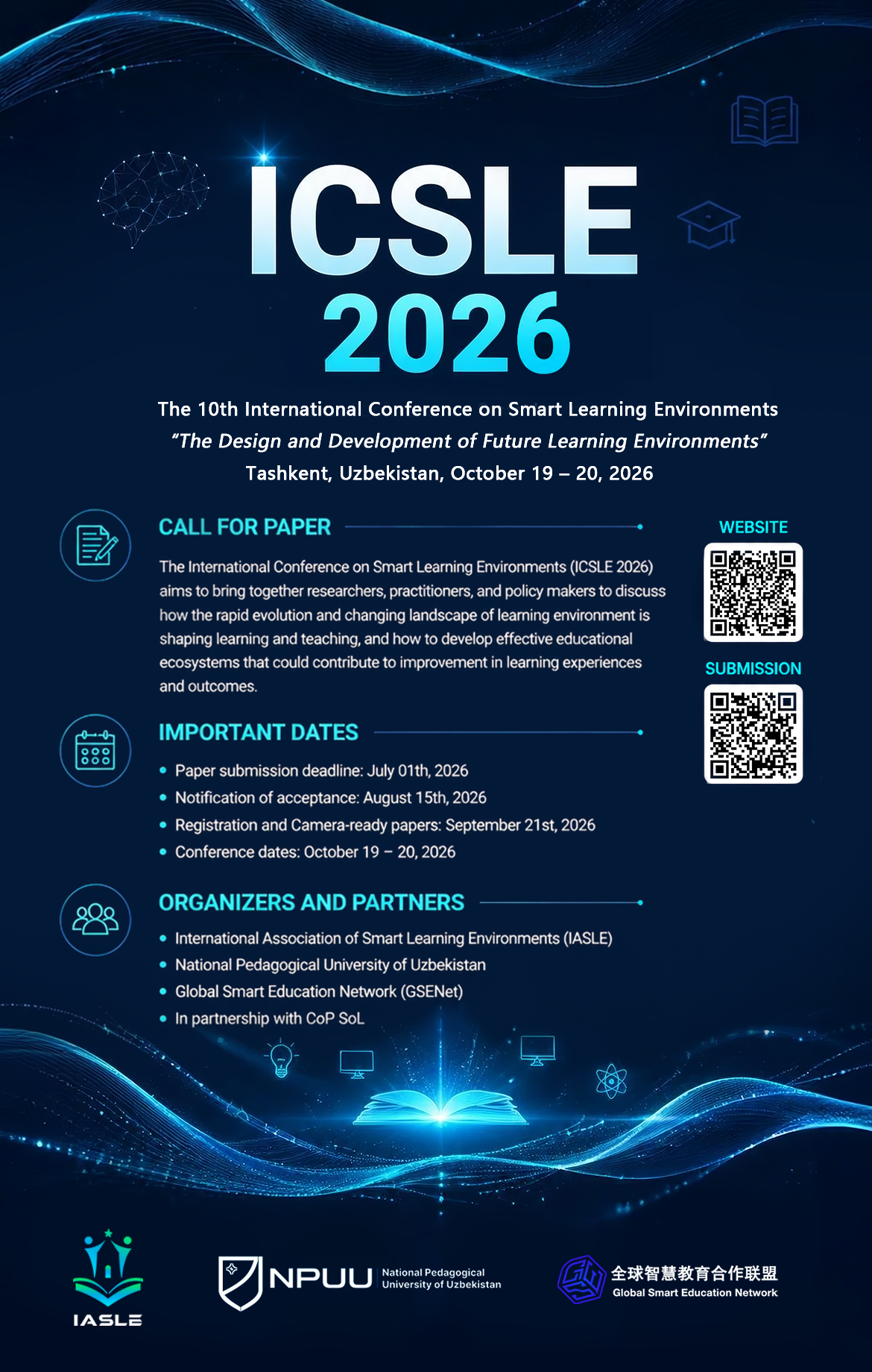
The 10th International Conference on Smart Learning Environments (ICSLE 2026) aims to bring together researchers, practitioners, and policy makers to discuss how the rapid evolution and changing landscape of learning environment is shaping learning and teaching, and how to develop effective educational ecosystems that could contribute to improvement in learning experiences and outcomes.
Tashkent, Uzbekistan, October 19 – 20
Paper submission deadline: July 01st,2026 July 17th,2026
Submission link: https://easychair.org/conferences/?conf=icsle2026
Call for Papers – ICSLE 2026
“The Design and Development of Future Learning Environments”
The International Conference on Smart Learning Environments (ICSLE 2026) aims to bring together researchers, practitioners, and policy makers to discuss how the rapid evolution and changing landscape of learning environment is shaping learning and teaching, and how to develop effective educational ecosystems that could contribute to improvement in learning experiences and outcomes. Various components of this interplay include but are not limited to:
Track 1: Educational technology grounded in science of learning — How science of learning and learning principals inform the design and development of educational technology. Also, how educational technology, such as learning analytics and artificial intelligence, contribute to science of learning.
Track 2: Pedagogy, learning approaches and instructional design. This includes approaches informed by theory, human or artificial intelligence, including game-based learning, gamification, inquiry-based learning, simulation, and work-integrated learning. Relevant topics include instructional design models, technology-enhanced teaching strategies, and practices that support active, experiential, and personalized learning across contexts.
Track 3: Human-machine collaboration, human dynamics and agency in the AI era. This includes all topics about how humans interact or collaborate with each other, with computers, AI, or intelligent machines at large. It also includes human-(ro)bot collaboration, avatars, digital twins, and the metaverse. Relevant issues of synergy in education — policies, applications, case studies, and best practices of domain-specific / subject-specific smart learning — are also included.
Track 4: Digital, machine and AI ethics in education — this includes ethical frameworks, guidelines, and policies for the responsible use of digital technologies and AI in education. Topics include general and generative AI ethics, teaching ethics in curricula, data privacy, algorithmic transparency, and the development of human-centered, inclusive, and accountable AI systems in learning environments.
Track 5: Smart school and digital campus—This track explores how AI is reimagining the forms, functions, and learning experiences of future schools in the intelligent age. It also examines how digital campuses can provide a systematic foundation for school transformation through standards-based planning, infrastructure, platforms, data governance, and service systems. Together, the track highlights both the future vision of schooling and the practical pathways for building high-quality, future-ready educational environments.
General Chairs
Dr. Ahmed Tlili, Beijing Normal University, China
Dr. Kinshuk, University of North Texas, USA
Dr. Ronghuai Huang, Beijing Normal University, Beijing
Dr. Farkhod Alisherov, National Pedagogical University of Uzbekistan, Uzbekistan
Dr. Dejian Liu, Beijing Normal University, China
Program Chairs
Dr. Asadulla Ashurov, National Pedagogical University of Uzbekistan, Uzbekistan
Dr. Maiga Chang, Athabasca University, Canada
Dr. Ting-Wen Chang, Beijing Normal University, China
Dr. Ahmed Hosny Saleh Metwally, National Pedagogical University of Uzbekistan, Uzbekistan & Capital University, Cairo, Egypt
Workshop chairs
Dr. Junfeng Yang, Hangzhou Normal University, China
Dr. Elvira Popescu, Finland
Local organizers
Dr. Ruzikulova Nigora, National Pedagogical University of Uzbekistan, Uzbekistan
M.D. Bekhzod Abdullaev, National Pedagogical University of Uzbekistan, Uzbekistan
M.D. Azizbek Kurbanov, National Pedagogical University of Uzbekistan, Uzbekistan
M.D. Rano Rakhimova, National Pedagogical University of Uzbekistan, Uzbekistan
M.D.Madinabonu Nazarova, National Pedagogical University of Uzbekistan, Uzbekistan
M.D. Kunduz Medetova, National Pedagogical University of Uzbekistan, Uzbekistan
Hosted as a Hybrid (Virtual and Physical) Conference by
International Association of Smart Learning Environments (IASLE)
National Pedagogical University of Uzbekistan
Global Smart Education Network (GSENet)
In partnership with Regional Community of Practice (CoP) on Science of Learning in the Asia-Pacific (CoP SoL)
Important Dates
Paper submission deadline: July 01st, 2026 July 17th,2026
Notification of acceptance: August 15th, 2026
Registration and Camera-ready papers: September 21st, 2026
Conference dates: October 19 – 20, 2026
Types of submissions
Experience Reports: Experience reports describe research-based technological implementation for education that worked well and is now recommended to others.
Full-length Experience Reports (maximum 10 pages): Full-length Experience Reports may contain detailed descriptions of research behind the implementation, development, evaluation or other applications. Work reported in Full-length Experience Reports must be original.
Short Experience Reports (maximum 6 pages): Short Experience Reports may contain brief reports of technologies developed, techniques used or results of research. Work reported in Short Experience Reports must be original.
Research Studies: Research Studies present a careful study, with an appropriate use of methodology (e.g., case study, qualitative methods, quasi-experimental, experimental) to support the investigation and stated results. The methodology does not need to be quantitative; it does, however, need to be appropriate to support the claims made by the author.
Full-length Research Studies (maximum 10 pages): Full-length Research Studies may contain detailed description of the background research, details of methodology used, findings of the study, interpretation of the findings, and resulting recommendations for other researchers/practitioners. Work reported in Full-length Research Studies must be original.
Short Research Studies (maximum 6 pages): Short Research Studies may focus on small-scale research experiments that may be extensions of author’s previously validated research. However, the work reported in Short Research Studies must be original.
Work-in-progress Papers (maximum 4 pages): Work-in-progress Papers contain original research frameworks, architectures and implementations, where initial results are available but full validation are not yet done. The originality of the work must be clearly visible.
Reflection Papers (maximum 4 pages): Reflection papers are expected to present an argument – with rationale and justification – for a different approach or perspective on solving a current educational problem through the use of emerging technology or through innovative use of existing technology. The work presented in the Reflection Papers must not have been published or submitted for publication) elsewhere.
Posters (maximum 4 pages): Posters are expected to briefly explain the idea of your research and argue its novelty. Posters are not intended to provide background research or details of a rigorous experimental study. They provide opportunity to sell your ideas to the audience. The work presented in the Posters must not have been published (or submitted for publication) elsewhere.
Author guidelines and and Presentation Guidelines
All papers must follow the conference template found on Author Guidelines – ICSLE 2026
Presentation Guidelines
- Presentation time for full papers will be 20 minutes plus 5 minutes for questions.
- Presentation time for short papers will be 15 minutes plus 5 minutes for questions.
- The poster session will be divided into two parts: the first part is a panel, in which each presenter has 5 minutes to briefly explain their work, and the second part is a regular poster exhibition. Please note that the poster boards are 130 cm high and 120 cm wide, so please prepare your posters accordingly (e.g. A0 size).
- Conference rooms will be equipped with laptops and video projectors.
- Please bring your presentation on a USB stick.
All accepted papers will be included in the conference proceedings published under Springer’s Lecture Notes in Educational Technology (LNET) series (https://www.springer.com/series/11777), which is Scopus indexed.
Registration fee
Regular Registration Fee:
| Non-students | Students |
| US$ 400 | US$ 200 |
Leave a Reply
You must be logged in to post a comment.