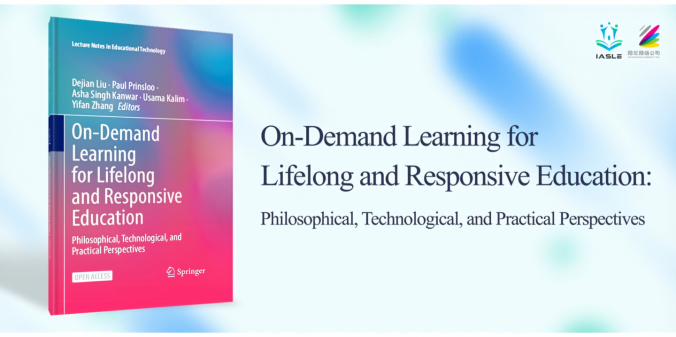
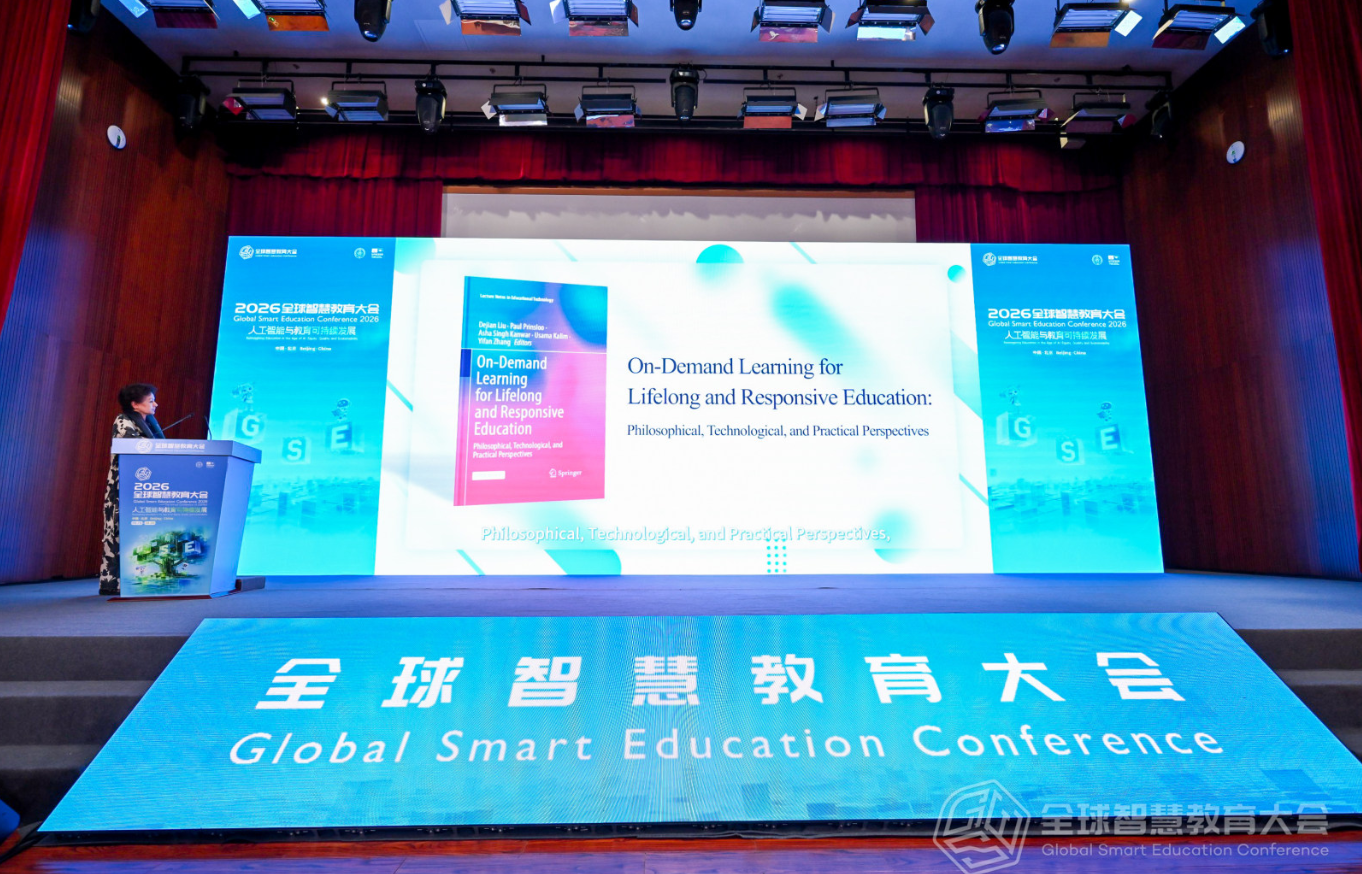
The IASLE-NetDragon Joint Research Project reached a major milestone with the publication of its new open-access book, On-Demand Learning for Lifelong and Responsive Education: Philosophical, Technological, and Practical Perspectives, published by Springer. To mark the occasion, the project hosted a roundtable discussion at the Global Smart Education Conference (GSE 2026) on August 20, bringing the book’s core questions to an international stage.
A Book Born of a Moment of Disorientation
Generative AI has unsettled assumptions that have organized education for decades – about what counts as knowledge, how competence should be assessed, what a qualification signals, and what it even means to learn something. Every institution is now asking the same questions: What should we still teach? What should we stop teaching? And if an AI can perform a task competently, does a human still need to learn how to do it?
This volume, edited by Dejian Liu, Paul Prinsloo, Asha Kanwar, Usama Kalim, and Yifan Zhang, enters this landscape through the lens of On-Demand Learning – the idea that learning should be modular, responsive, and available at the point of need. But it quickly becomes something larger: a multi-perspective inquiry into how AI, platformization, and modular credentialing are reshaping the entire relationship between knowledge, learner, and work.
· Published as an open-access volume, the book is freely available to anyone, anywhere – no paywall, no subscription.
From Philosophy to Practice
Rather than starting with technology, the book begins where the editors believe we must: with philosophy, and the uncomfortable questions that technical debates tend to bypass. What does acceleration do to the deeper purposes of education? When does flexibility stop being a solution and become a new problem? Whose knowledge counts when learning becomes platform-driven, and whose is quietly excluded?
From there, seventeen chapters from scholars across the Global North and Global South move into the realities of practice: AI-guided reflection systems that help professionals bridge formal training and workplace application; virtual reality training for firefighters; AI-enabled smart glasses that embed learning into the flow of work; and micro-credentialing frameworks that are already reshaping institutional learning pathways.
Crucially, the volume centers voices that are too often absent from these debates. Scholars working in and from the Global South examine On-Demand Learning not as an imported model, but as something shaped by local conditions, local innovation, and local priorities – from modular learning pathways opening doors for women into the drone economy, to Brazil’s public health systems, to the community-led Equity Unbound network operating across more than twenty countries.
The book also takes governance seriously. Analyses of India’s national lifelong learning policies and comparative case studies across eight countries reveal that scaling modular learning depends less on technology than on institutional coordination, policy coherence, and the difficult work of making flexibility compatible with credible recognition. Looking ahead, the volume examines vocational education under conditions of perpetual reskilling and the emerging role of micro-credentials in countries such as Mauritius and Namibia.
The Roundtable at GSE 2026
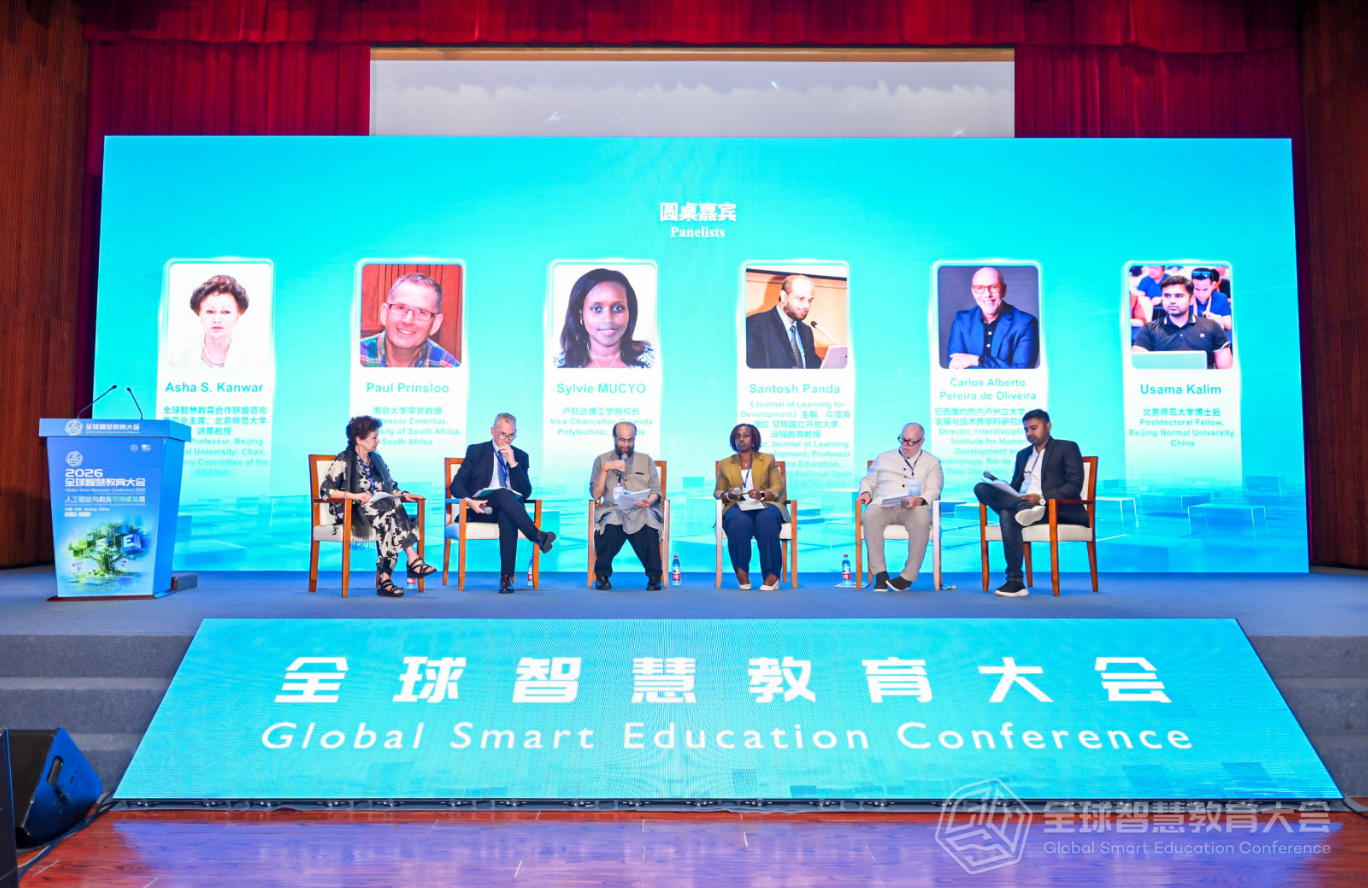
To bring these ideas into live conversation, the project hosted a roundtable at the Global Smart Education Conference on August 20, moderated by Professor Asha Kanwar and featuring an international panel: Paul Prinsloo, Santosh Panda, Carlos Alberto Pereira de Oliveira, Sylvie Mucyo, and Usama Kalim.
Drawing on more than three decades of experience in education, Professor Kanwar opened by situating the present moment within the longer arc of educational change. Distance education expanded access but did not replace traditional institutions. MOOCs created excitement but also revealed the complexity of democratizing learning at scale. What makes this moment distinct, she argued, is how Generative AI and the demand for immediate, just-in-time skills are fundamentally reorganizing the relationship between knowledge, the learner, and work. On-Demand Learning, in this framing, is not just a delivery mode, but a new paradigm.
A Table with Many Voices
What makes this volume distinctive is not any single chapter, but the conversation the chapters create together. Philosophers sit alongside researchers exploring wearable AI; policy analysts share space with community organizers building learning networks from the ground up. This is intentional – the questions AI raises for education cannot be answered from within a single discipline.
The book launch video, featuring all five editors, was also screened at the roundtable, offering attendees a concise introduction to the volume’s vision.
The IASLE-NetDragon Joint Research Project extends its gratitude to every contributing author, the editorial team, the reviewers, and the Springer publishing team. This was a truly collaborative international effort.
For readers interested in what AI means for how we teach, how we learn, and how we prepare people for a changing world, the book is freely available via Springer: https://link.springer.com/book/9789819251964
Leave a Reply
You must be logged in to post a comment.